Piazza Savonarola
The HummingbirdPiazza Savonarola is the Carrera family’s Florence home, a domestic setting whose furniture and rooms preserve the family’s beauty, divisions, and losses long after its members have scattered or died. For Marco Carrera, the house is not simply property to sell: its objects hold the material trace of a life that no longer exists, while its rooms continue to make the absent family present. The house’s history runs from childhood scenes of conflict to Marco’s repeated efforts to protect, document, and finally inhabit it at the end of his life.
The family home and its objects
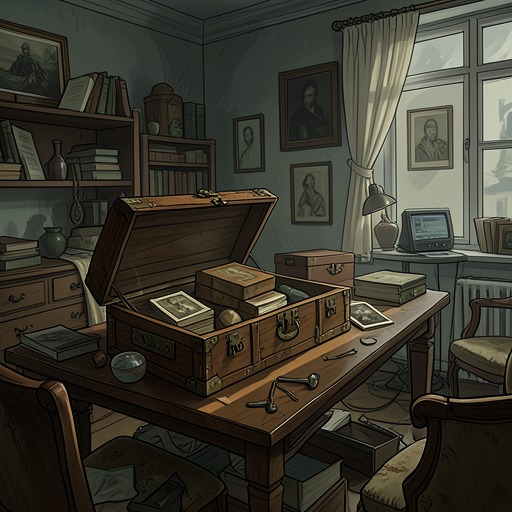
The house first appears as the setting in which Marco grows up among the furniture, lamps, tables, armchairs, sofas, desks, and modular bookcases collected by his parents. Their tastes and temperaments were profoundly different, but in their choice of objects their distance seemed to disappear. As an adult, Marco recognizes that the rooms had helped give him a sense of living in an unusually beautiful world. The furnishings had seemed to testify to that world’s perfection, even after he understood how much had been concealed beneath the appearance of family unity.
That beauty gives the objects their unusual emotional force. Marco’s attachment is not merely nostalgia for a childhood home: even when the family, in a technical sense, no longer exists, he struggles to part with what surrounded his parents. He imagines the objects one by one as he faces the prospect of selling the house, and the act of imagining them makes their hold on him stronger. The house’s contents preserve an ideal of beauty that once seemed to bind his parents together, though that beauty could not resolve their irreconcilable differences.
The furnishings also embody the contrast between the parents. Probus Carrera kept his own things in a rigid, absolute order, a manner Marco experienced as intimidating and ultimately violent; in reaction, Marco became contemptuously untidy. The home therefore retains not one shared family memory but the marks of competing habits and influences, reproduced in the son who carries elements of both parents while resisting others.
Childhood conflict behind the closed door
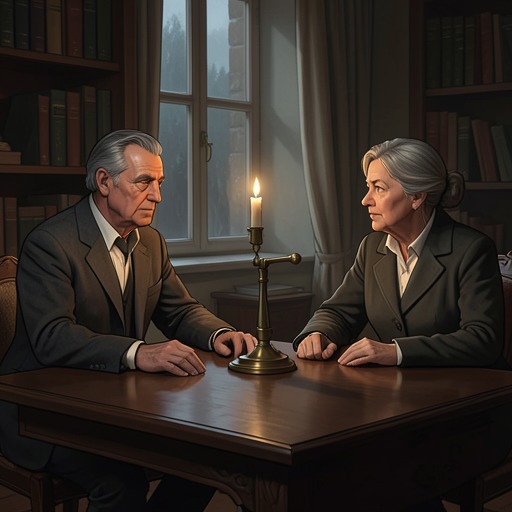
In the early 1970s, Piazza Savonarola is the setting for an argument between Letizia Delvecchio and Probus that their children unexpectedly overhear. Their quarrels were usually conducted in whispers, so that Irene, who spied on them, was generally the only child who knew they were happening. This time Marco and Giacomo join Irene behind the door of their mother’s room after the argument has become loud. They do not understand that Marco’s unusually slow physical development is the subject of the dispute; Irene, having followed the quarrel from its beginning, does.
The argument moves from the question of Marco’s growth to a wider conflict over ideas, with the parents hurling insults and disputing a book about the relationship between form and development. Their children fear that the quarrel means their parents will separate. Irene, now an adult, refuses to accept that outcome and confronts them at the door. Her intervention makes the parents apologize to one another and helps lead them to repair the breach rather than separate. In retrospect, the narrator presents this moment as consequential for the future of the family, including Marco’s, while the reason for the quarrel remains unknown to him at the time.
The episode makes the house more than a shelter for family life: its doors and rooms organize what each child can know. Marco and Giacomo hear the quarrel but miss its cause; Irene’s position as watcher gives her knowledge the others lack. Piazza Savonarola thus holds both the family’s conflicts and the uneven distribution of their secrets.
Sale, preservation, and an absent sister
Years later, Marco writes to his brother Giacomo about the planned sale of the house and asks him to take part in deciding what will happen to its contents. He has obtained an estimate from Piero Brachi, the furniture dealer who supplied the family for two decades and now runs a design auction site. Many pieces are valuable, some are in excellent condition, and Brachi says that some comparable objects are exhibited at the Museum of Modern Art. Marco reports a total estimate of €92,800, while making clear that the decision is not just financial: the furniture is what remains of a life and a family in which the brothers shared more than twenty years.
Marco proposes that Brachi sell the pieces gradually, or that the brothers divide them according to need or attachment. But he resists Giacomo’s suggestion to get rid of them. He promises to follow his brother’s wishes if Giacomo will participate in the decision, and insists that the objects are innocent. The request for his brother’s involvement gives the house a further meaning: its contents are a surviving common inheritance, and deciding their fate is one of the remaining ways the estranged brothers might act together.
The house’s planned sale is repeatedly postponed in practice. During a later visit, Marco says that it is deteriorating and ought to be emptied, put in order, and rented, though selling it does not seem sensible during the crisis. He has turned off the gas but left the water on so the house can still be cleaned if needed. He does not go there to clean; he goes to check. His routine is an act of watchfulness without a settled plan for the property, a way of keeping it from simply falling apart while its future remains unresolved.
Rooms that preserve the dead
During one of these visits, Marco goes into Irene’s room, which his parents had kept intact: the bed made, the room clean, and everything arranged as if she might return. He remembers the blue bedspread, the orderly desk, the shelves, two lamps, the guitar, records and record player, the posters, and a dollhouse his father had made for her. Previously, he had usually only looked into the room and left; he believed that nothing could go wrong there anymore. This time, he sits on the bed, switches on the lamp, and takes a place at the desk.
The room’s apparent emptiness proves deceptive. Marco had thought there was nothing on the desk beyond the lamp, a National Geographic planisphere under glass, and a framed image connected with The Rocky Horror Picture Show. Instead, he finds a book that had been there all along. The discovery gives the carefully preserved room a new charge: its stillness has not meant an absence of history, only that Marco had not seen what remained. The house can contain memories he has not yet managed to recognize, even in a room he has visited repeatedly.
The room’s preservation also distinguishes Irene’s absence from the general decline of the house. Elsewhere, Marco worries about leaks and breakdowns; Irene’s room had been maintained as a space ready for her return. That gesture belongs to the parents’ continuing attachment to their daughter, and Marco encounters it not as a practical matter but as an inheritance of mourning. The unchanged objects make the room peaceful to him, yet his decision to sit there and handle its furnishings breaches the untouched order he has long respected.
The house as archive and final room
Marco’s work on the house also leads him to confront his mother’s photographic archive, which had been left there and which he had found difficult to handle. The photographs unsettled him because they opened onto a world of architects, designers, artists, and other people in his mother’s life, while his father seemed absent from it. When Marco finally examines the collection closely, he recognizes its importance: it includes black-and-white portraits, an extensive group of images of women architects, sequences documenting design objects from studio work to factory production, and records of radical architecture exhibitions and visual-poetry events. Among photographs of the 1966 Florence flood, he finds one image of Probus among the mud angels outside the National Library, wearing boots and a cape, his face lit by a lamp and a cigarette at his lips. The archive, like the house, preserves a family presence that is sparse, incomplete, and newly visible when Marco looks again.
The collection is eventually repaired and found a home at the Dami Tamburini Foundation. Marco declines an offer of twenty thousand euros and donates it, treating the transfer as a way to preserve the archive rather than turn it into another sale. This action contrasts with the unresolved fate of the furniture: some parts of the family’s material inheritance can be entrusted to a public collection, while the house itself remains bound to the intimate work of memory.
By the time Marco is dying, the living room at Piazza Savonarola has been transformed into a hospital room. Miraijin proposes a final gathering of people from Marco’s life, including Giacomo, Luisa Lattes, Marina, and Daniele Carradori. Marco is astonished by the proposal and initially doubts that they could come; Miraijin tells him she will take care of it. The reunion occurs in the house twelve days before the later scene at the sea. A home that had once been the setting of childhood, conflict, and decades of unanswered correspondence becomes the place where the scattered survivors are brought together before Marco’s death.
A house held in place while life changes
In the imagined future, Piazza Savonarola remains one of the old houses Miraijin can visit with an escort, alongside the house in Bolgheri. Marco is expected to wait for her there while her public work and threatened life require her to travel and live in secrecy. The future vision makes the house an anchor in a world that has changed around him: Marco stays in place, while Miraijin moves between hidden locations and a growing community of followers.
That image echoes the house’s earlier role without making it a simple refuge. Its rooms contain the family’s objects, its unresolved disagreements, the preserved room of a dead daughter, and the records of a past that Marco first avoided and later tried to protect. At the end, the house can hold a hospital bed and a final gathering; in the future, it can still be a place to return to. Piazza Savonarola endures not because it restores the family that once lived there, but because its rooms give their absences, belongings, and surviving relationships a place to remain visible.